
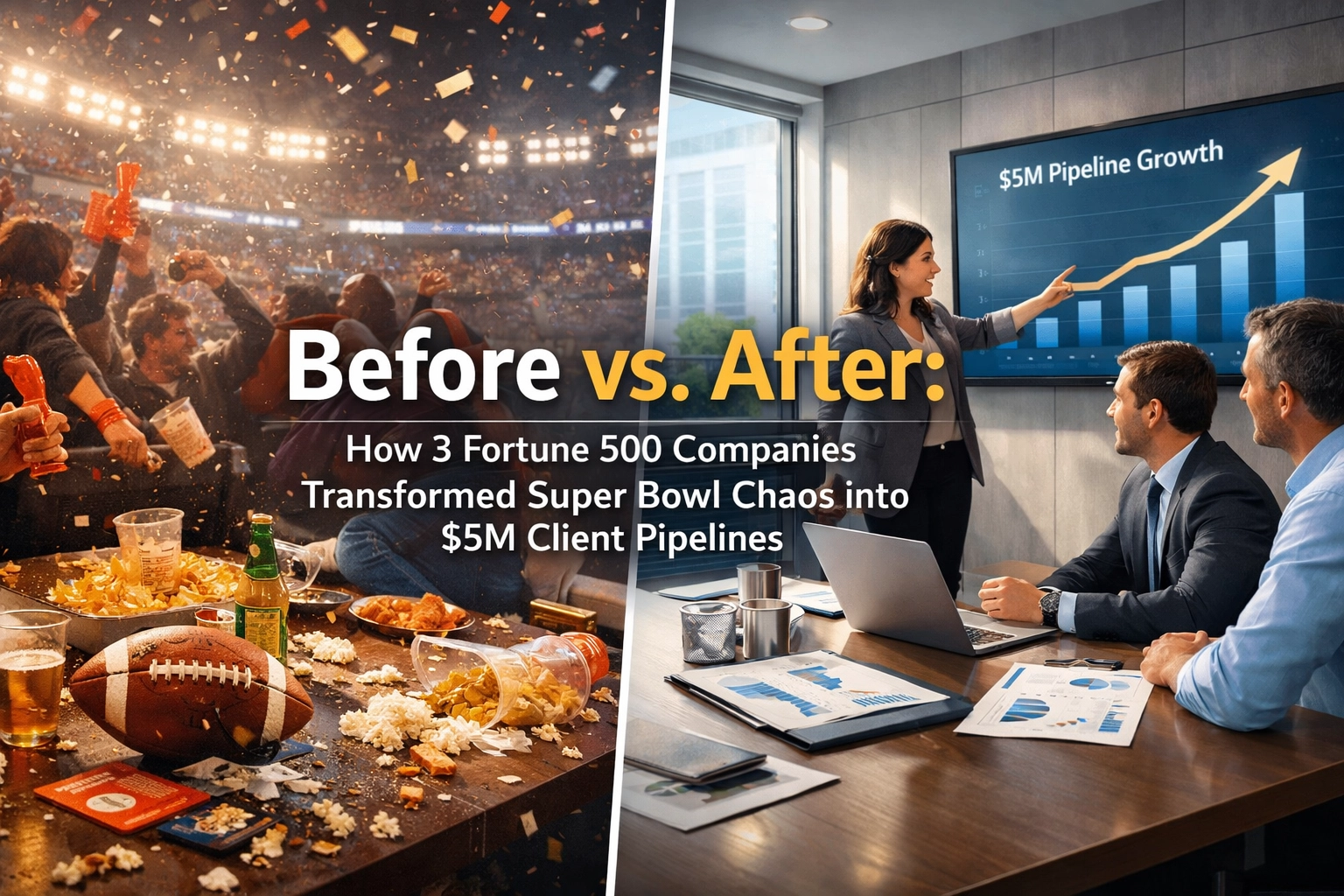
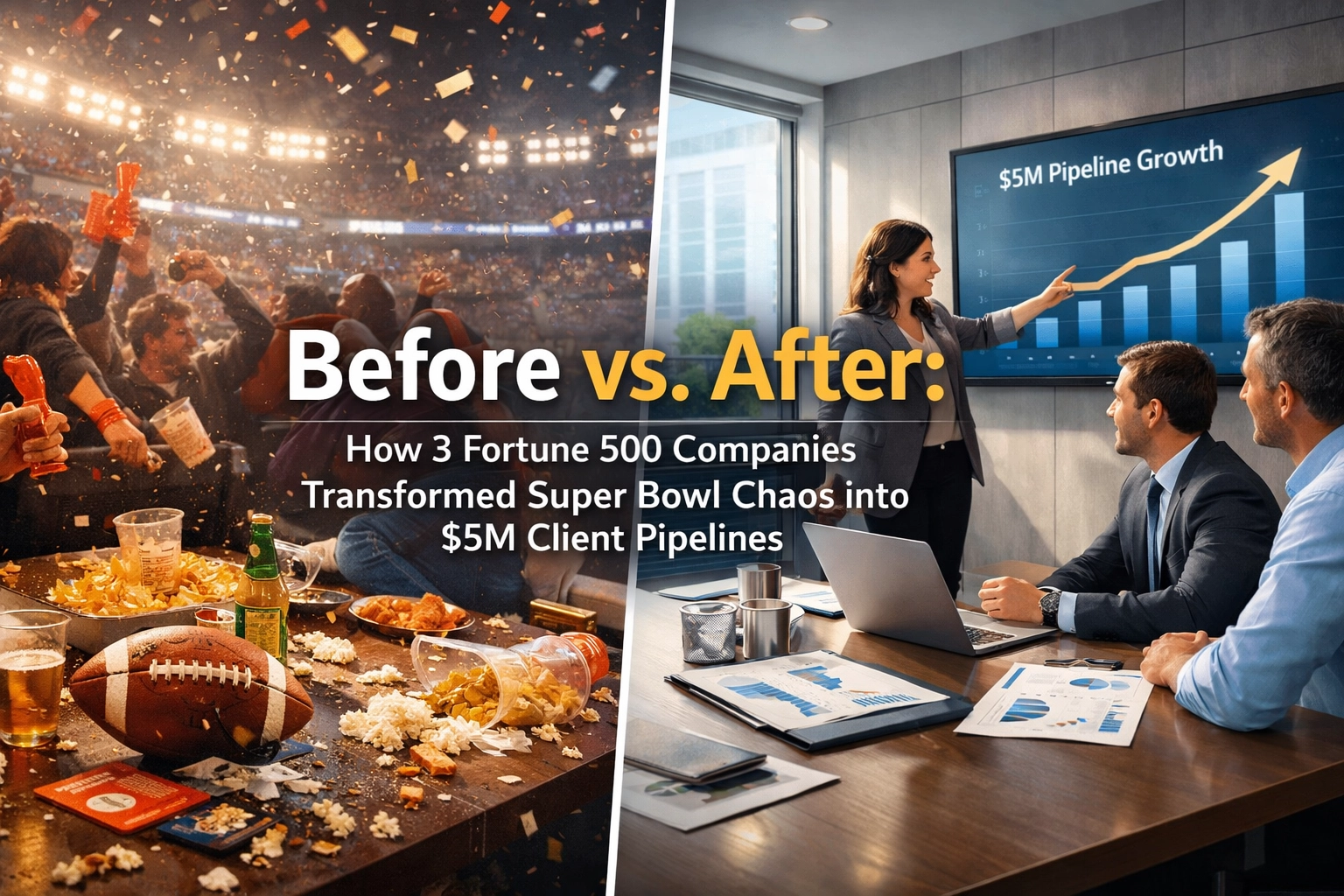
You've seen the headlines about Super Bowl advertising ROI. But what you haven't heard about is the hidden goldmine that happens off-screen: where Fortune 500 companies turn VIP hospitality chaos into multimillion-dollar client relationships.
The numbers tell a compelling story. While average Super Bowl ROI climbed from $2.70 per dollar in 2020 to $5.20 in 2023, the real winners weren't just running ads. They were orchestrating executive experiences that opened doors to deals worth exponentially more than their investment.
Let's pull back the curtain on three companies that figured out what most executives miss: the Super Bowl isn't just a marketing opportunity. It's your most powerful client acquisition event of the year: if you know how to manage the logistics.
Company #1: The Tech Giant That Stopped Winging It
Before: The $2M Missed Opportunity
A leading enterprise software company had been bringing 25 C-suite prospects to the Super Bowl for three consecutive years. Their approach? Book premium suites, hire a local transportation company, and hope for the best.
The reality was far from premium. Clients arrived to their suite at different times because ground transportation got tangled in game-day traffic. Half the executives missed the pre-game reception entirely. Two VIPs ended up sharing a ride with strangers when their assigned vehicle never showed. The company's head of client relations spent the entire event playing logistics firefighter instead of building relationships.
The result? Zero closed deals in the 90 days following the event. Their $2M investment in tickets, suites, and entertainment delivered exactly zero measurable pipeline growth.
After: The $5.7M Transformation
Year four, they changed everything. They partnered with a specialized corporate travel management team that treated the Super Bowl like the mission-critical business event it was.
Every client received a personalized itinerary 48 hours before arrival. Dedicated transportation coordinators monitored flight schedules in real-time, adjusting ground logistics as delays happened. VIP security escorts ensured seamless venue access. Each executive experienced white-glove service from airport pickup to post-game departure.
But here's where it gets interesting. With logistics running flawlessly in the background, the sales team could focus entirely on relationship building. They hosted intimate pre-game dinners. They facilitated meaningful connections between prospects. They created moments that couldn't happen over Zoom.
Within 90 days, they closed $5.7M in new business directly attributed to Super Bowl relationship building. Five prospects who had been "considering" their platform for months signed contracts. Three cold prospects who attended became warm leads that converted within the quarter.

Company #2: From Generic Hospitality to Strategic Networking Hub
Before: Throwing Money at the Problem
A Fortune 100 financial services firm believed premium tickets equaled premium results. They spent $800K annually taking clients to the Super Bowl, treating it like any other corporate entertainment event.
Their approach was transactional: give clients an expensive experience, hope they remember you when contract renewal time comes. They booked standard hotel blocks, used ride-sharing apps for transportation, and relied on venue staff for security and coordination.
The feedback was lukewarm at best. "Nice event" was the most common response. Client retention improved slightly, but new business development remained flat. The CMO couldn't justify the expense when pressed by the CFO.
After: Engineering Connection Points
Everything shifted when they reframed the Super Bowl as a strategic networking summit rather than a client entertainment perk.
They reduced their guest list from 40 to 25 but doubled down on experience quality. Each invitation became strategic: mixing current clients with high-value prospects and industry influencers. They created curated networking sessions before and after the game, designing conversation opportunities around shared business challenges.
The logistics became surgical. Private airport terminals eliminated travel stress. Coordinated ground transportation turned commute time into additional networking opportunities. Security and concierge teams anticipated needs before they became problems.
Check out how leading companies are maximizing these opportunities: Why Your Competitors Are Winning at Super Bowl Networking
The transformation was immediate. Six new partnerships formed directly from connections made during the weekend. Two prospects who met at their pre-game reception collaborated on a joint RFP that the financial services firm won: a $3.2M contract they wouldn't have even known about without facilitating that introduction.
Total new business attributed to the event: $4.8M in closed deals, with another $7M in active pipeline. The CFO stopped questioning the investment.

Company #3: When Last-Minute Chaos Became Competitive Advantage
Before: The Crisis That Wasn't Supposed to Happen
An industrial manufacturing company planned their Super Bowl executive summit a year in advance. Everything was booked, confirmed, and paid for. Then, three weeks before the event, their primary contact at their hospitality vendor quit. The new account manager had never handled an event of this scale.
Transportation schedules didn't match flight arrivals. Suite catering allergies weren't documented. Security credentials weren't processed. The week before the event, their internal team worked 80-hour weeks trying to salvage their plan.
Game day was survival mode. Executives were frustrated. The company's CEO spent more time apologizing than networking. Several key prospects left early, citing "scheduling conflicts." In reality, they were avoiding the amateur-hour logistics.
The aftermath was brutal. Not a single meaningful business conversation happened that weekend. Their $1.5M investment produced zero measurable results and damaged relationships with three VIP prospects.
After: Turning Crisis Into White-Glove Excellence
The following year, they took a different approach. Instead of trying to manage Super Bowl logistics in-house, they partnered with specialists who lived and breathed corporate event management.
The transformation started with a detailed discovery process. What were their business objectives? Who were their priority relationships? What did success actually look like?
From there, every detail was engineered backward from their goals. Ground transportation wasn't just about getting from Point A to Point B: it was about creating comfortable environments for relationship building. Suite experiences weren't just about watching the game: they were about facilitating the right conversations at the right moments.
They implemented real-time monitoring systems, backup plans for every critical element, and 24/7 concierge support for any issue that arose.
For more strategies on managing executive comfort and logistics, explore this resource: Your 48-Hour Playbook for Flawless Super Bowl Executive Experience
The results exceeded expectations. Their CEO closed a $2.1M deal during a private pre-game dinner with a prospect who had been "thinking about it" for 18 months. Three additional prospects moved from cold to warm leads, with two converting within 60 days for a combined $3.4M.
Total pipeline impact: $5.5M in new business, with multiple relationships strengthened for future opportunities.

The Common Thread: Logistics Create Trust, Trust Creates Deals
Here's what these three companies discovered: when you eliminate friction from the executive experience, you create space for the relationships that matter.
Your prospects aren't impressed by chaos management: they're impressed when there's no chaos to manage. They notice when every detail works seamlessly. They remember when they felt genuinely valued rather than treated like generic VIP ticket recipients.
The Super Bowl offers a unique combination of excitement, exclusivity, and extended face-time with decision-makers. But only if the logistics don't get in the way.
See how this plays out in real corporate scenarios: https://www.youtube.com/watch?v=l6J-0zileKE
What This Means for Your Next Big Event
You don't need to invest $2M to generate pipeline-changing results at major sporting events. But you do need to treat the logistics as strategically as you treat the guest list.
Start by asking yourself these questions:
Is your transportation strategy creating networking opportunities or killing them? Shared rides between the right people can spark million-dollar conversations. Random ride-sharing apps can't.
Are you designing for relationship building or just attendance? Premium tickets don't automatically create premium results. Strategic seating, curated networking moments, and facilitated introductions do.
Do you have real-time crisis management or are you hoping nothing goes wrong? Hope isn't a strategy. Professional event teams monitor every element and adjust before small problems become big embarrassments.
Are you measuring the right outcomes? Attendance numbers don't matter. Pipeline growth, relationship advancement, and closed deals matter.
The companies that transform Super Bowl investments into multimillion-dollar pipelines understand one fundamental truth: the experience you create reflects the partnership you're offering. When every detail exceeds expectations, prospects start imagining what working with you might feel like.
For additional insights on maximizing your corporate travel ROI, visit USA Entertainment Travel to explore comprehensive solutions designed for executive-level experiences.
Your Next Play
The difference between chaos and conversion isn't luck: it's logistics. The Fortune 500 companies getting this right aren't managing it themselves. They're partnering with teams who specialize in turning complex corporate events into seamless relationship-building opportunities.
Your competition is already implementing these strategies. The question isn't whether to invest in major sporting events: it's whether you'll execute them in a way that actually moves the needle for your business.
Ready to transform your next big event from expensive entertainment into measurable pipeline growth? Let's talk about what that looks like for your organization.
Contact USA Entertainment Travel:
Phone: +1 970-709-0037
Email: info@usaev.com