

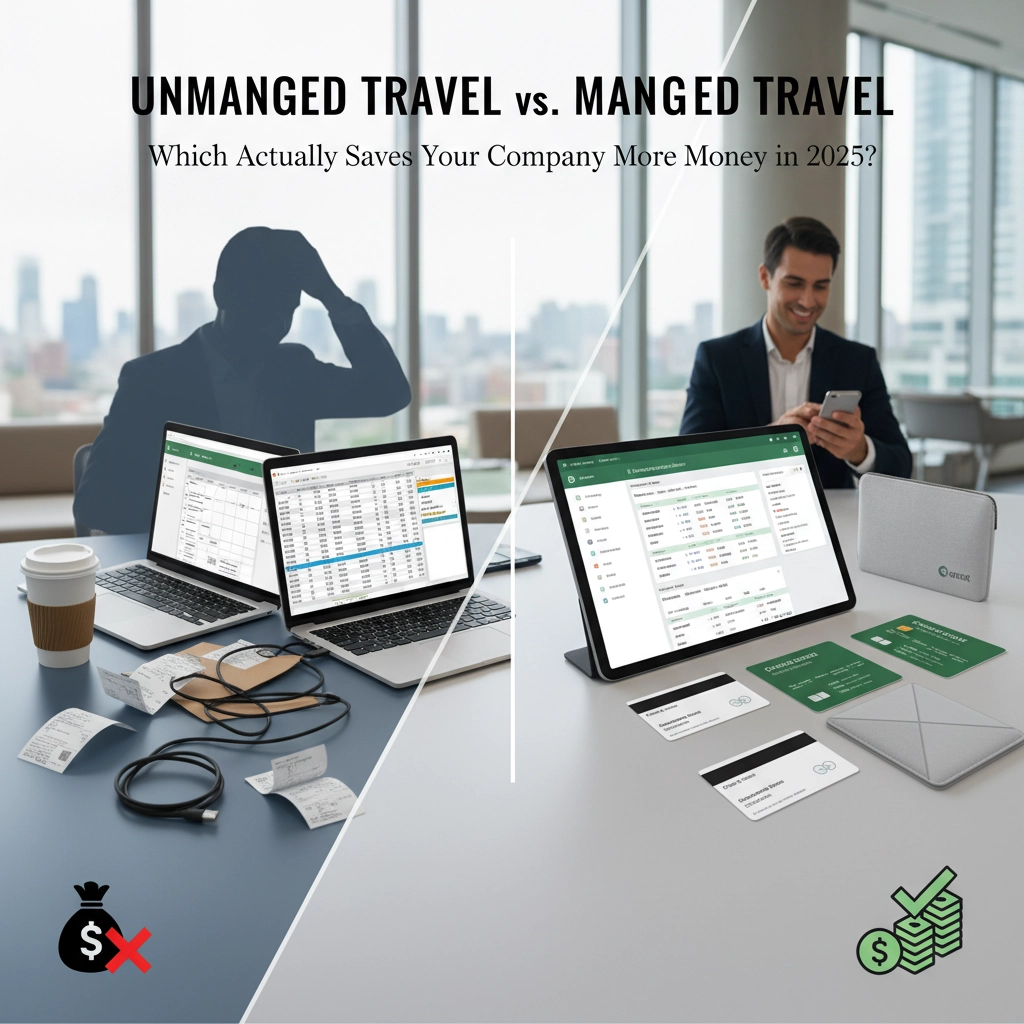
You're watching your company's travel expenses climb month after month, and you're starting to wonder if there's a better way to manage this growing budget line item. With global business travel spending projected to reach nearly $2.9 trillion by 2029, the stakes have never been higher for getting your travel management strategy right.
The choice between unmanaged and managed travel isn't just about convenience, it's about protecting your bottom line. Companies using unmanaged travel approaches are consistently overspending by up to 24% compared to those with structured programs. That's where the real cost of "saving money" by avoiding travel management services becomes crystal clear.
The Hidden Financial Drain of Unmanaged Travel
When you allow employees to handle their own travel bookings without centralized oversight, you're essentially leaving money on the table. Unmanaged travel creates a perfect storm of inefficiencies that compound into significant financial losses.
Your employees book wherever they find convenient, often choosing premium options or making last-minute reservations that cost substantially more than necessary. Without standardized policies, there's no framework guiding these decisions, and what seems like employee autonomy quickly becomes budget chaos.

The data visibility problem amplifies these costs. Your bookings scatter across multiple platforms, some employees use Expedia, others prefer direct airline websites, and a few might even call travel agents directly. This fragmentation makes it impossible to track spending patterns, identify cost-saving opportunities, or negotiate volume discounts with suppliers.
You're also missing out on supplier relationships entirely. Without consolidated booking volume, you lose all leverage for negotiating better rates with airlines, hotels, and ground transportation providers. Each transaction happens in isolation, paying full retail prices when managed programs typically secure 15-30% discounts through preferred vendor agreements.
The administrative burden multiplies your costs beyond the actual travel expenses. Your finance team spends countless hours chasing paper receipts, processing incomplete expense reports, and trying to reconcile scattered transactions. Manual expense management isn't just inefficient, it's expensive, with processing costs that can add 10-15% to your total travel spend.
Managed Travel: Your Strategic Cost-Reduction Solution
Managed travel programs flip this equation entirely, delivering measurable savings through structured processes and professional oversight. Companies implementing managed travel and expense programs realize an average of 20% annual savings, with some organizations achieving up to 30% cost reductions through negotiated supplier rates.
Your managed travel partner brings immediate value through consolidated booking platforms that integrate policy compliance directly into the reservation process. When employees book travel, they automatically see only policy-compliant options, eliminating the guesswork and reducing out-of-policy spending that drives up costs.
The supplier leverage advantage becomes apparent immediately. Travel management companies negotiate volume discounts across airline, hotel, and ground transportation providers, passing these savings directly to your organization. These aren't marginal improvements, they're substantial cost reductions that compound with every business trip.

Data visibility transforms from your biggest challenge into your greatest asset. Comprehensive reporting provides real-time insights into spending patterns, enabling you to identify trends, forecast budgets accurately, and make strategic decisions based on complete information rather than scattered spreadsheets.
Your administrative overhead virtually disappears. Automated invoicing, mobile receipt capture, and integrated expense management systems eliminate the manual processing burden while accelerating employee reimbursements. This operational efficiency translates directly into cost savings through reduced processing time and improved cash flow management.
The risk management component adds another layer of value. Professional travel support handles disruption management in real-time, minimizing the hidden costs associated with travel changes, cancellations, and emergency rebooking. This proactive approach prevents the expensive reactive scrambling that characterizes unmanaged travel during disruptions.
The Numbers Game: Direct Comparison
| Cost Factor | Unmanaged Travel | Managed Travel |
|---|---|---|
| Average Overspend | Up to 24% above optimal rates | 20-30% savings through negotiated rates |
| Booking Platform | Multiple sites, inconsistent pricing | Centralized platform with policy compliance |
| Supplier Discounts | None – paying retail rates | Volume discounts across all suppliers |
| Policy Compliance | Reactive enforcement, frequent violations | Proactive policy integration |
| Data Visibility | Fragmented, incomplete reporting | Comprehensive, real-time analytics |
| Administrative Costs | High manual processing overhead | Automated systems, minimal admin burden |
| Risk Management | Reactive, costly emergency responses | Proactive 24/7 professional support |
| Expense Processing | Slow, error-prone manual systems | Fast, accurate automated workflows |
Market Reality Check for 2025
You're not alone in grappling with this decision. Currently, only 35% of global business travel spending flows through managed programs, meaning roughly 65% of that projected $2.9 trillion remains unmanaged. This represents a massive opportunity for organizations ready to capture these savings.
The urgency intensifies when you consider that 85% of businesses expect their travel costs to increase over the next five years. Without proactive cost management strategies, you're essentially planning to spend more while leaving proven savings opportunities untapped.

The competitive advantage becomes clear when you realize that companies implementing managed travel programs are systematically reducing costs while their competitors continue overspending through unmanaged approaches. This cost differential compounds over time, creating substantial advantages in operational efficiency and financial performance.
Strategic Implementation: Making the Transition Work
Your transition to managed travel doesn't require a complete operational overhaul. Start by establishing clear travel policies that define booking parameters, preferred suppliers, and approval workflows. These policies become the foundation for compliance and cost control.
Select a travel management company that aligns with your organization's size, complexity, and geographic requirements. The right partner brings established supplier relationships, proven technology platforms, and dedicated support that immediately begins delivering value.
Employee adoption drives success, so focus on communicating the benefits clearly. Emphasize how managed travel simplifies the booking process, provides better support during disruptions, and often delivers superior travel experiences through preferred supplier relationships.
Monitor and measure results consistently. Your managed travel program should provide detailed analytics demonstrating cost savings, policy compliance rates, and operational improvements. These metrics validate your investment and identify opportunities for continuous optimization.
The Clear Winner: Managed Travel Delivers Superior Financial Results
Managed travel programs consistently outperform unmanaged approaches across every financial metric that matters. The combination of 20-30% savings potential, elimination of the 24% unmanaged overspend, and reduced administrative overhead creates a compelling financial case that strengthens over time.
Your organization benefits beyond pure cost savings. Enhanced policy compliance reduces financial risk, comprehensive data visibility enables strategic decision-making, and professional support minimizes disruption-related costs. These operational improvements contribute to your bottom line while improving employee satisfaction and productivity.
The recommendation is straightforward: managed travel delivers superior financial outcomes for organizations of virtually every size. Whether you're managing a large enterprise travel budget or growing your program at a mid-sized company, the cost advantages of managed travel outweigh the investment required to implement these programs.
Your next step is evaluating managed travel solutions that align with your specific requirements and beginning the transition that will start delivering savings immediately. The longer you wait, the more money you're leaving on the table through unmanaged overspend.
Ready to explore how managed travel can transform your organization's travel spending? Contact USA Entertainment Travel at +1 970-709-0037 or email info@usaev.com to discuss your specific requirements and discover your savings potential.