
PRESS RELEASE: 10 Reasons Your Super Bowl Transportation Logistics Aren’t Working (And How to Fix It)
The Super Bowl is not merely a football game; it is a massive, complex machinery of human movement that demands surgical precision. When your corporate hospitality plans intersect with the largest sporting event on the planet, the margin for error disappears. If your guests are stranded in traffic or trapped in security bottlenecks, your brand’s reputation is what pays the price. Managing logistics for such an event requires more than a fleet of vehicles; it requires a strategic architecture that accounts for every variable from airport tarmac to stadium suite.
At USA Entertainment Travel, we see the patterns that lead to logistical failure. Understanding these pitfalls is the first step toward securing a seamless experience for your high-value stakeholders.
1. You Are Underestimating the "Return Surge"
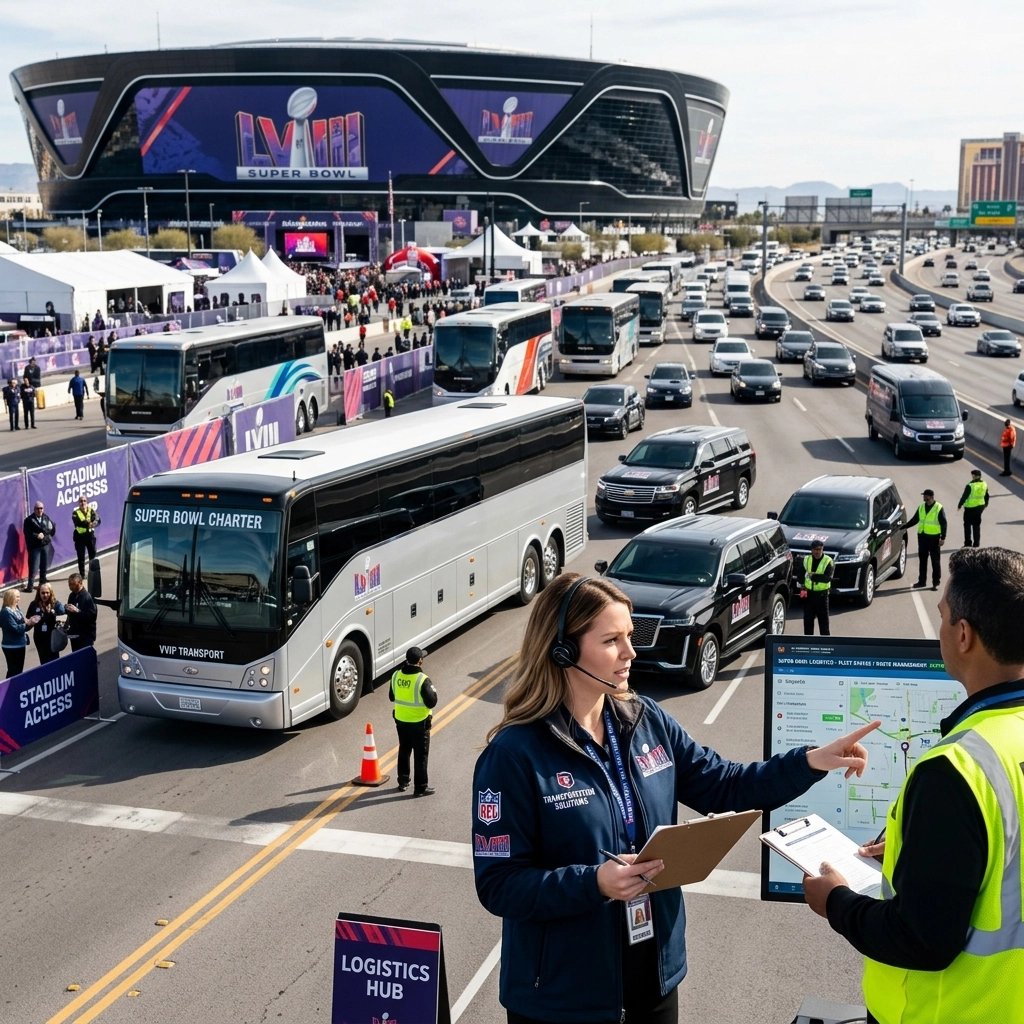
The most common point of failure occurs after the trophy is raised. While arrivals are often staggered over several hours, the departure is a simultaneous exodus of 70,000+ people. Most logistics plans fail because they account for the trip to the stadium but ignore the gridlock of the return.
The Fix: You must implement a "Tiered Extraction Strategy." This involves pre-staged vehicles in priority zones and real-time coordination with stadium exit gates. By staggering your guest departures through post-game hospitality, you allow the initial wave of congestion to break before your VIPs ever hit the road.
2. Fragmented Communication Chains
If your driver, your dispatch, and your on-site host are not operating on a single, unified communication channel, your logistics are already compromised. Relying on standard cellular networks during a Super Bowl: where towers are consistently overloaded: is a recipe for "dead zones" and missed connections.
The Fix: Establish a dedicated Command Center. Use encrypted, high-bandwidth communication tools that bypass standard consumer networks. Ensure that every moving part of your operation is visible on a single dashboard. You can learn more about our integrated approach at https://travel.usaev.com/services-brands.

3. Security Checkpoint Bottlenecks
You can have the most luxurious motorcoach in the world, but if it is stuck behind 400 other vehicles at a security perimeter, your timeline is irrelevant. Many organizations fail to account for the secondary and tertiary security screenings required for vehicles entering the "Red Zone" or "Gold Zone."
The Fix: Deploy "Advance Scouts." These are team members positioned at key checkpoints to provide minute-by-minute updates on queue lengths. Furthermore, ensure all your vehicle and driver credentials are submitted and vetted weeks in advance through proper compliance channels.
4. Ignoring Geographic Complexity
Every Super Bowl host city presents a unique set of geographic challenges. Whether it is the bridges of the Bay Area or the sprawling highways of Phoenix, generic GPS mapping does not account for the "Event-Day Only" road closures and one-way directional shifts mandated by local law enforcement.
The Fix: Dive deep into the local "Traffic Management Plan" (TMP). Your routes should be designed by professionals who have walked the ground and mapped the physical barriers that digital maps ignore. Watch how we navigate these complexities here: https://www.youtube.com/watch?v=l6J-0zileKE.
5. Improper Vehicle Scaling
A common mistake is choosing the wrong tool for the job. Large motorcoaches offer capacity but lack the agility to navigate tight urban corridors or designated drop-off points. Conversely, a fleet of small SUVs creates a coordination nightmare.
The Fix: Audit your guest list and match the vehicle to the specific venue access. Use "Hybrid Fleets": agile executive sprinters for inner-circle movement and high-capacity luxury coaches for larger group transfers. This balance ensures both comfort and maneuverability.

6. Relying on "Consumer-Grade" Transportation Apps
In the high-stakes environment of the Super Bowl, relying on standard ride-sharing apps is a catastrophic risk. Surge pricing, driver cancellations, and the inability of "app-based" drivers to access restricted VIP lanes will leave your guests frustrated and late.
The Fix: Secure dedicated, professional chauffeurs who are specifically trained for "High-Security Event" (HSE) protocols. These drivers don’t just follow a map; they understand the etiquette of corporate hospitality and the importance of brand representation.
7. Neglecting the "First and Last Mile"
The journey doesn't start at the hotel door and end at the stadium gate. It starts the moment your guest lands at the FBO (Fixed Base Operator) and ends when they are safely back in their suite. Many logistics plans have "blind spots" at the airport and within the stadium's pedestrian zones.
The Fix: Create a "Concierge Loop." Your logistics should include "Greeter Teams" at the airport and "Wayfinders" at the stadium. These human touchpoints bridge the gap between the vehicle and the destination, ensuring your guests never feel lost or unattended.
8. Inadequate Contingency Buffers
If your plan relies on everything going right, you don't have a plan. Traffic accidents, sudden weather shifts, or security lockdowns can happen in an instant. Without a "Plan B" (and a Plan C), a single delay can derail your entire weekend.
The Fix: You must build "Buffer Assets" into your budget. This means having "Hot Standby" vehicles and drivers positioned at strategic points, ready to deploy the moment a primary route or vehicle is compromised. Excellence in logistics is defined by how you handle the unexpected.

9. Poor Signage and Wayfinding
Even with the best transportation, guests can become confused at the point of disembarkation. If your guests have to search for their vehicle in a sea of identical black cars, the "VIP feeling" is immediately lost.
The Fix: Implement "High-Visibility Branding." Use digital signage, branded uniforms for greeters, and customized vehicle identifiers. Every transition should be visually cued so the guest flows naturally from one stage of the journey to the next. Review our company policies on brand standards to see how we maintain this level of detail.
10. Late-Stage Implementation
The biggest reason Super Bowl logistics fail is that the planning starts too late. By the time the playoff brackets are set, the best assets, the closest parking permits, and the most experienced drivers are already booked.
The Fix: Commit to your logistics architecture six to twelve months in advance. Secure your permits, vet your vendors, and lock in your fleet while the inventory is still high-quality. Early action is the only way to guarantee the premium access your brand deserves.
The USA Entertainment Travel Advantage
Navigating the Super Bowl requires more than just a map; it requires a partner who understands the intersection of high-level logistics and corporate brand strategy. You need a team that anticipates the surge, masters the geography, and prioritizes the security of your guests above all else.
The initial impression your corporate hospitality makes is crucial, and that's where your transportation strategy either shines or falters. That's why we emphasize a proactive, data-driven approach to every mile traveled. Hook your readers with the promise of a flawless event, and then deliver it with the precision that only an expert guide can provide.
Dive deep into your planning today and transform your Super Bowl presence from a logistical challenge into a competitive advantage. When you eliminate the friction of travel, you allow your guests to focus on what matters: the game, the networking, and your brand.
For a comprehensive consultation on your Super Bowl LXI logistics or to review our available assets, contact our executive team today.
Contact Information:
USA Entertainment Travel
Phone: +1 970-709-0037
Email: info@usaev.com
Website: https://travel.usaev.com
Watch our logistics in action: https://www.youtube.com/watch?v=l6J-0zileKE